Where Should I Start with AI? A Practical Guide
AI offers countless possibilities – and that is precisely what paralyses. A practical guide to the right first step: why administration is the ideal starting point and how five questions help you find the right process.

English edition — originally published in German as Wo soll ich mit KI anfangen? Ein praktischer Leitfaden.
Artificial intelligence can do an astonishing amount today: write texts, read documents, hold conversations, detect patterns in large datasets. To companies, this sounds like limitless possibility. And that is precisely where the difficulty begins – because when everything is possible, nothing is obvious.
The most common question we hear at Deep Impact is therefore not "Does AI work?". It is: "Where should we start?" This guide gives a concrete, practical answer – step by step.
Too many options paralyse
A seemingly endless choice sounds tempting, but in practice often leads to standstill. Some companies wait for "the best" opportunity to appear – and in the end do nothing. Others jump straight into a large, visible flagship project and fail because the first step was simply too big.
Both are avoidable. The key is not to find the one perfect AI application. It is to choose a good first step: one that shows impact quickly, stays manageable, and builds trust.
How not to start
Three false starts stand out in particular:
:::callout{type="warning"}
- With the most spectacular use case – the one currently making headlines.
- With whatever the competition is allegedly doing – out of fear of missing out.
- With the technology itself – "We need a chatbot now too".
:::
All three share one thing: they start with the technology, not with a real problem. Anyone introducing a tool without knowing which concrete task it should solve ends up buying complexity instead of relief.
The simple rule: start with the most tedious
The best starting point for AI is not the most intelligent use case – it is the most tedious. The decisive question is not "Where can AI impress the most?" but: "Where do we have the most recurring manual work?"
Because wherever people perform the same routine tasks by hand day after day, the benefit is greatest, most quickly visible – and easiest to calculate. And in most companies, this routine work concentrates in one place: administration.
> Don't start with the most spectacular use case – start with the most tedious one.
Why administration is the ideal starting point
Administrative and back-office processes meet almost every condition for a good first AI use case – on five counts:
Stage 1: High manual effort
Capturing invoices, transferring data, filing documents: administrative work consists largely of repetition. This is exactly where AI can take over the most.
Stage 2: Clear, rule-based workflows
Administrative processes mostly follow fixed rules. That makes them well-suited for AI – and their results comprehensible and predictable.
Stage 3: Easy to measure
How many transactions per day, how many minutes per transaction? In administration, these numbers are known. The business case can be calculated cleanly.
Stage 4: Low risk
Internal processes have no direct customer contact. An error here is less critical and easy to correct – ideal conditions for the first step.
Stage 5: Quickly visible success
Hours saved are felt immediately. Such quick wins create acceptance in the team and momentum for the next steps.
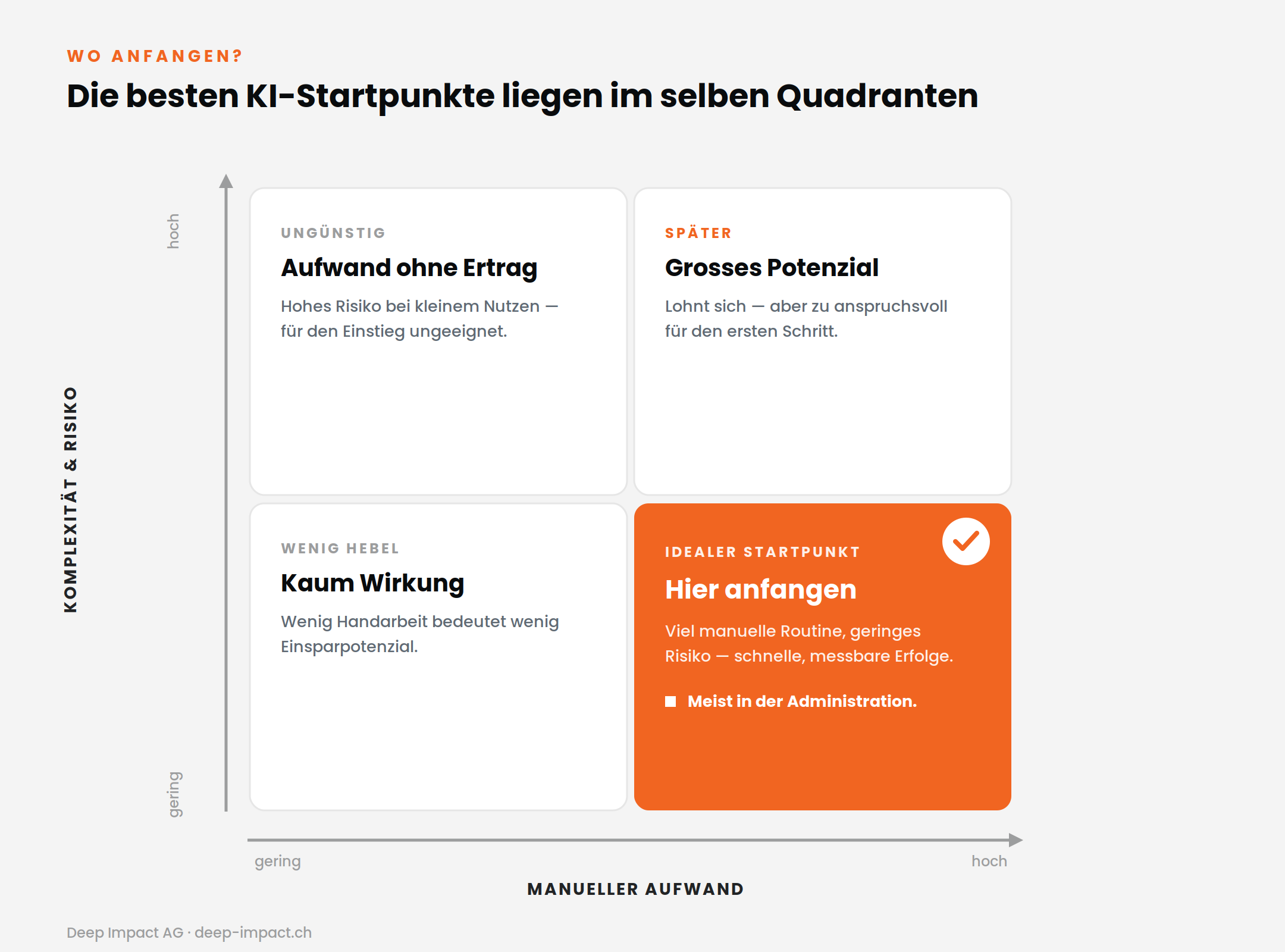
!The ideal AI starting point lies where high manual effort meets low complexity and low risk.
The practical guide: five questions to find your starting point
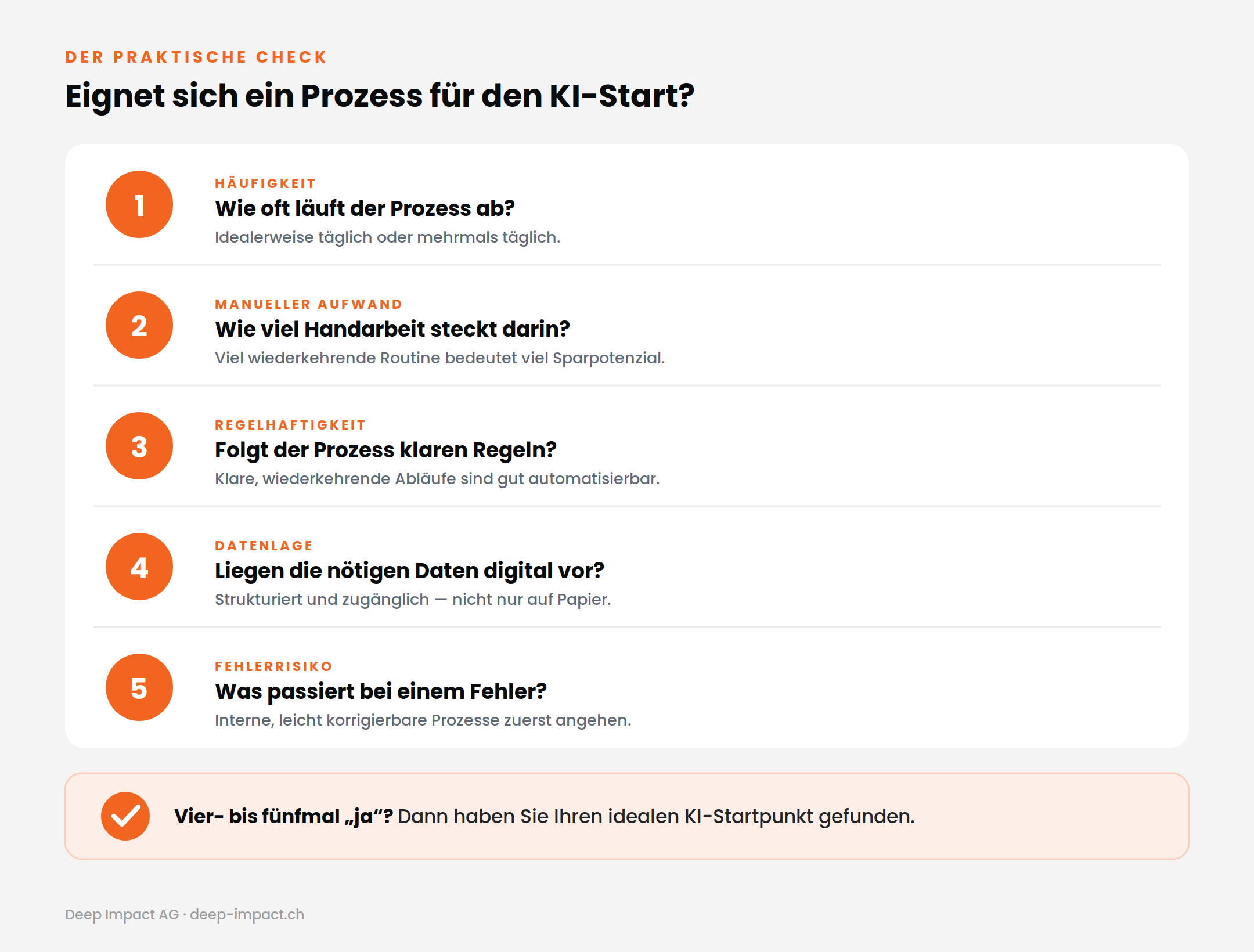
The insight "somewhere in administration" narrows the field – but does not yet name a concrete process. You find that with a simple approach: list your administrative workflows and score each one against five questions.
The more often you can answer "yes", the better the process is suited. The candidate that convinces on four or five questions is your starting point.
!The 5-point check: a simple grid for assessing administrative processes for their AI suitability.
Concrete: where AI pays off quickly in administration
These administrative processes meet the five criteria particularly often – good first places to look in your own company:
- Invoice processing – Automatically extract, validate and prepare incoming invoices for posting.
- Order and purchase capture – Transfer orders from emails into the ERP system in a structured way.
- Document filing – Automatically classify incoming documents and file them in the right place.
- Master data maintenance – Reconcile, transfer and check data for consistency across systems.
- Standard requests – Automatically answer or pre-qualify recurring internal requests.
- Reporting – Automatically compile evaluations and recurring reports.
Three signs of a good candidate
Sometimes a casual remark in the team is enough to reveal that a process fits. Listen for sentences like these:
> The same person always does that here, in exactly the same way.
> There is a clear instruction or checklist for it.
> We could say fairly precisely how many hours per week this costs us.
If such statements apply to a process, a closer look is worthwhile – chances are good that you have found one.
And then?
Once you have found a candidate, implementation does not start immediately. The next step is the honest question: does it really pay off? How a promising candidate becomes an economically sound project – without expensive failures – is described in our article on the 4-stage approach.
:::takeaways{title="Key Takeaways"}
- The problem with starting AI is not too little choice – it is too much.
- The best starting point is not the most spectacular, but the most tedious process.
- Administration offers ideal first use cases: lots of manual work, clear rules, low risk, measurable benefit.
- Five simple questions lead from "somewhere in administration" to a concrete process.
- Start small and internal – quick wins build trust for the bigger steps.
:::