The 4-Step Approach: AI Automation with a Business Case
Artificial intelligence is on everyone's lips – but there's often a large gap between the hype and successful implementation within a company. At Deep Impact, we follow a clear principle: no AI project without a business case.

English edition — originally published in German as Der 4-Stufen-Ansatz: KI-Automatisierung mit Business Case.
Artificial intelligence sits on every management agenda today. Yet between the excitement in the boardroom and an AI system that genuinely reduces cost in daily operations lies a surprisingly large gap. Most AI initiatives don't fail because of technology — they fail because nobody ran the numbers upfront to see whether they were worth it.
At Deep Impact we take the opposite route. Instead of starting with the technology, we start with the math. Our principle fits in a single sentence: no AI project without a business case. This article shows how our 4-stage approach makes AI automation predictable, low-risk, and economically verifiable.
The core problem: hype is not a plan
Most organisations approach AI with the same three questions: Where do we start? Is the investment worth it? And how do we avoid expensive failures? That uncertainty is justified — but it must not become a barrier to action.
The real trap is something else: projects start because the technology is impressive, not because the value is clear. A striking demo doesn't replace an economic case. Anyone who introduces an AI tool without knowing which specific problem it solves and at what scale is buying complexity, not relief. AI is not an end in itself.
Calculate first, then act
Our approach is deliberately pragmatic. Before we write a single line of code, we answer the decisive question: Does it pay off? Together with our clients we analyse existing workflows, identify concrete automation opportunities, and quantify the expected return on investment.
Behind this stands a clear stance: AI should simplify systems, not complicate them. A well-placed automation replaces manual effort — it doesn't add another layer that itself needs maintenance. Exactly this discipline is what the 4-stage approach makes visible to both sides.
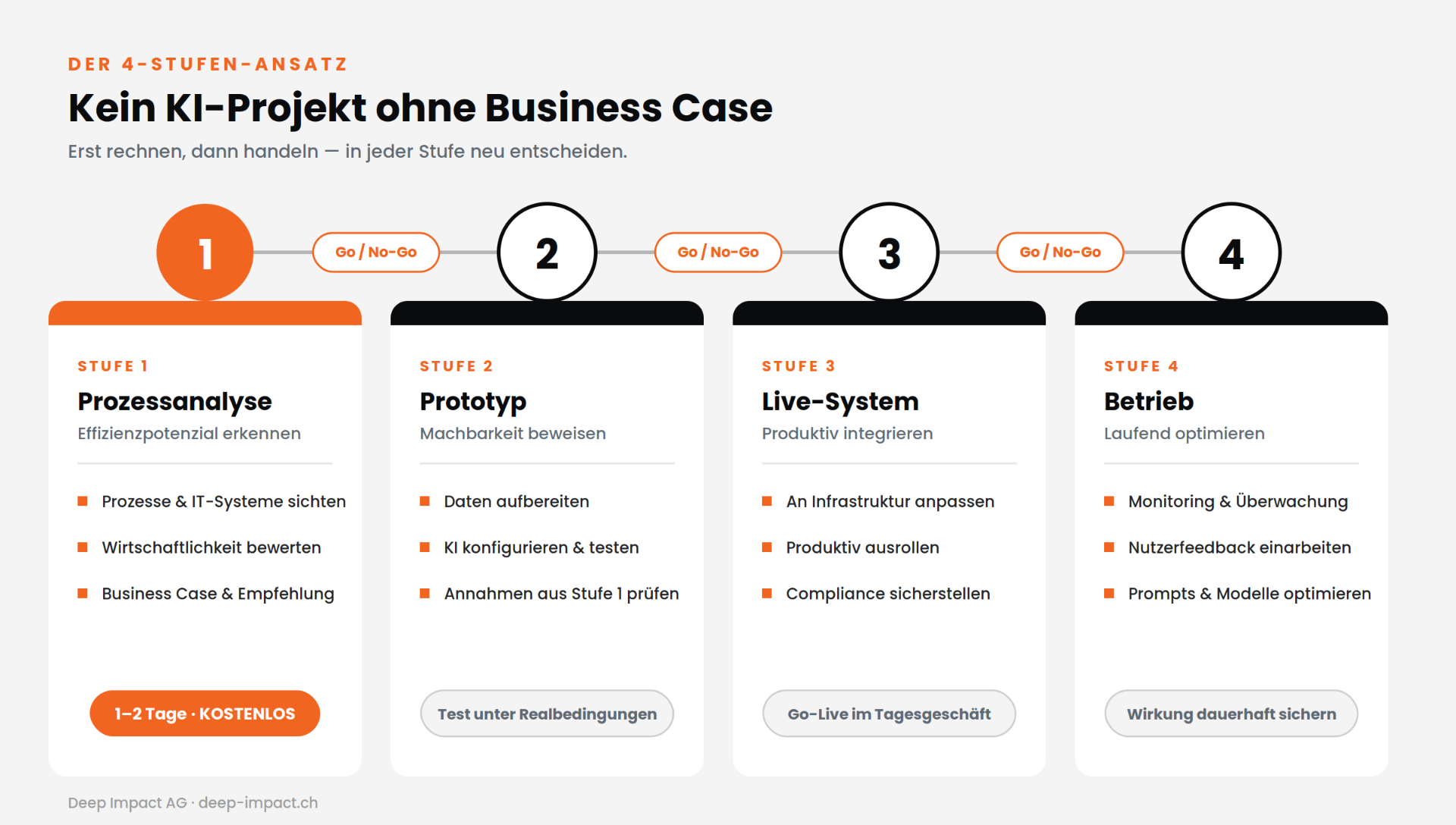
Four sequential phases with a Go/No-Go decision after each stage (graphic in German).
The four stages in detail
Stage 1 — Process Analysis & Efficiency Potential
Where does AI actually pay off? This stage is free for you — a real offer with real value. In one to two days we analyse your processes and IT systems, assess economic efficiency, and give concrete recommendations.
- Analysis of the existing process and IT landscape
- Assessment of economic efficiency
- Concrete recommendations with a business case
Why free? Because the analysis already creates value in itself: you receive a solid picture — even if you ultimately decide against a project. And it is an honest filter. If AI does not pay off at this point, we tell you so.
Stage 2 — Prototype: the feasibility study
Does it work with your data? Only when the business case convinces do we build a working prototype. Here the technical feasibility is tested under real conditions — not in a polished demo, but with your actual data.
- Data provisioning and preparation
- Prompt engineering and AI configuration
- Validation of the assumptions from Stage 1
The prototype answers the second critical question: does the technology deliver what the calculation promised? The assumptions from Stage 1 are either confirmed — or corrected before larger budgets flow.
Stage 3 — Live System: productive integration
From test to operations. After a successful prototype phase, integration into your production environment follows. The solution is adapted to your infrastructure and rolled out so that it fits seamlessly into daily work.
- System adaptation to your infrastructure
- Productive system implementation
- Strategy and compliance alignment
At this point the value is already doubly secured: economically in Stage 1, technically validated in Stage 2. The productive investment therefore happens not on suspicion, but on the basis of proven results.
Stage 4 — Operations & continuous optimisation
Go-live is the beginning, not the end. With commissioning the project is not finished. AI systems live in a changing environment: data, processes, and requirements evolve — the solution must evolve with them.
- Continuous monitoring and oversight
- Further development based on user feedback
- Prompt and model optimisation for better results
This way the impact built up in the earlier stages is preserved permanently — and improves a little with every iteration.
Why this approach works
The decisive mechanism lies in the transitions between the stages. Every transition is a deliberate decision point — a Go or No-Go. You never invest on suspicion, always on the basis of what the previous stage has proven.
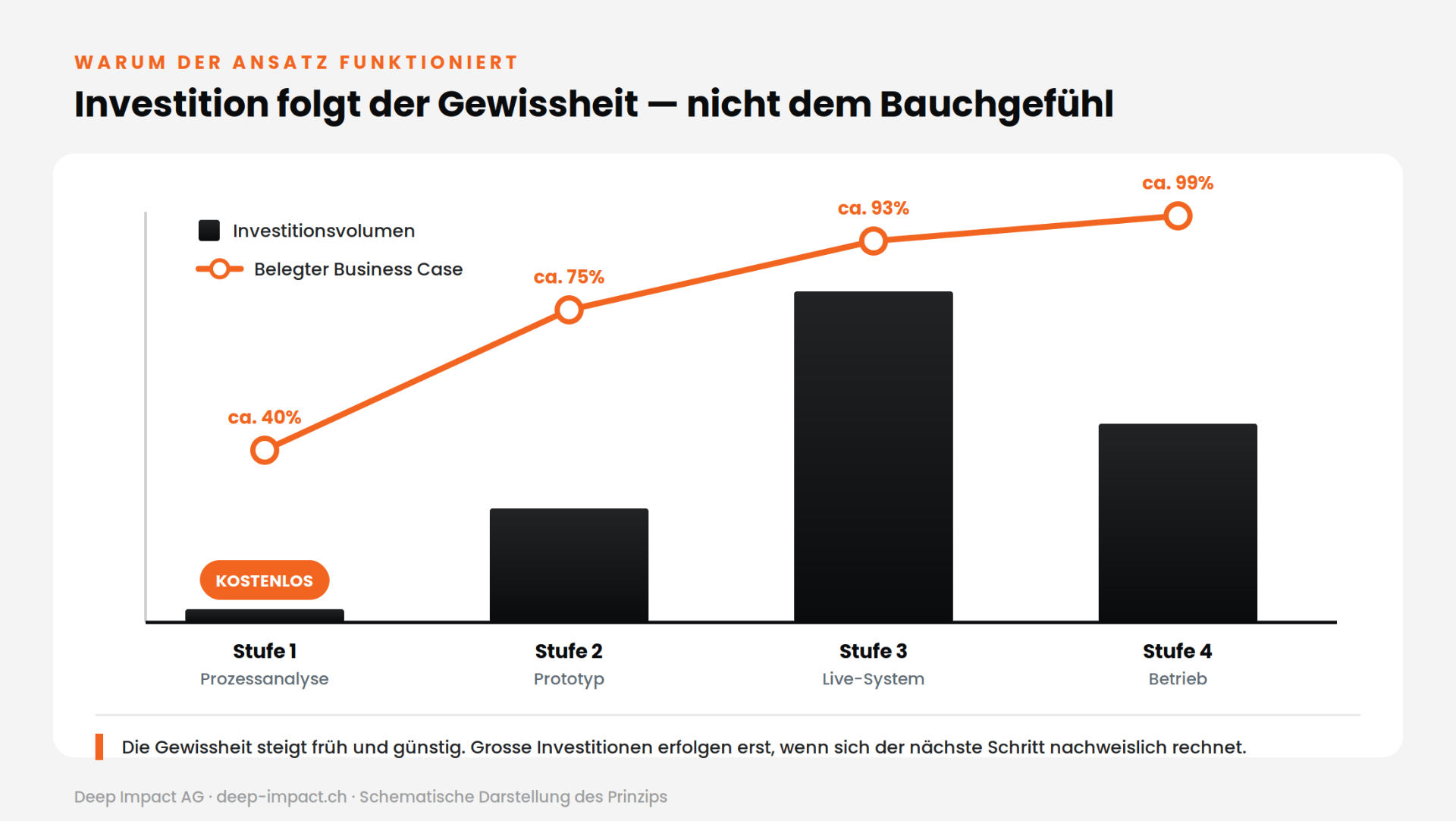
Certainty about economic viability rises early and cheaply. Significant investments follow only once the business case is proven (graphic in German).
Risk minimisation
Through the free initial analysis and the step-by-step build-up, you invest only where the deployment demonstrably pays off.
Transparency
In every phase you know exactly where you stand — and what the next step costs.
Measurability
The business case is continuously re-checked. Promised efficiency gains do not remain theory but are proven at every stage.
Flexibility
After every phase you decide anew whether to continue. Control stays with you at all times.
What it looks like in practice
A typical scenario to illustrate: an industrial company receives orders by email — in all kinds of formats and wordings. Today an administrative assistant transfers each of these orders by hand into the ERP system.
In Stage 1 exactly this workflow is measured: How many orders arrive per day? How much time does each entry take? What is the error rate? From these numbers the business case emerges. It answers the question: if an AI captures most orders automatically and reliably, how many working hours are freed up — and how does this gain relate to project costs?
Only once that calculation works out do we move into Stage 2, where the prototype uses real sample emails to show whether the capture meets the required quality. What sounds abstract here becomes a traceable sequence of decisions — each one backed by numbers.
> AI is not an end in itself. Every automation must pay off — and that is precisely what we ensure with our approach.
The 4-stage approach makes AI projects predictable, measurable, and economically accountable. It takes the speculation out of AI adoption without taking away its ambition — and turns a gut feeling into a verifiable investment decision.
Key takeaways
- AI projects rarely fail because of technology — most often because of a missing business case.
- The 4-stage approach checks economic viability before investing.
- Stage 1 is free: a sound assessment with no risk and no obligation.
- After every stage you decide anew — control stays with you.
- The value is measured throughout, from first concept to ongoing operations.