150 hours of additional capacity: How CFOs assess the AI business case
A planning example from CLEO shows how less work can create additional capacity, and what evidence a sound AI business case still needs.

English edition — originally published in German as 150 Stunden mehr Kapazität: So prüfen CFOs den KI-Business-Case.
An AI application promises to cut the work required for a quotation from four hours to one and a half. At 60 quotations a month, that would mean 150 fewer hours of work. An attractive figure. For an investment decision, however, the real work starts here: Which activities are included? Does quality remain the same? And how can the time gained actually be used?
Using a planning example from our CLEO product, we show how CFOs and COOs can assess such a calculation.
:::callout{type="info"} The times below are assumptions, not measured customer results. :::
:::takeaways{title="For your decision"}
- The 150 hours represent potential capacity in an illustrative calculation.
- Review, rework and actual adoption determine the impact.
- A specific use for the time and a complete cost assessment turn this into a business case.
:::
The practical context: from customer request to quotation
CLEO is our AI-first platform for tailor-made tour operators. The product approach connects customer information, AI-assisted itinerary drafts, partner enquiries and quotation costing. Partner proposals received as documents are intended to feed into subsequent processing after expert review. This addresses a specific workflow: gathering, transferring and checking information, then turning it into a quotation.
Its value therefore cannot be measured solely by how quickly AI generates an itinerary. What matters is the entire journey to a checked quotation that is ready to send. Research, price checks, follow-up questions and corrections belong in that assessment.
The principle applies elsewhere too: technical quotations, service orders and purchase preparation all depend on a usable work product.
The calculation: 240 hours become 90
The CLEO planning example uses three assumptions: 60 quotations per month, four hours of work per quotation today and one and a half hours in future. For a sound comparison, the future time must include all checks and rework up to the same completion point.
| Metric | Current process | Target assumption | |---|---:|---:| | Quotations per month | 60 | 60 | | Work per quotation | 4 hours | 1.5 hours | | Work per month | 240 hours | 90 hours |
:::highlight 60 × (4 − 1.5) = 150 hours of additional capacity per month. :::
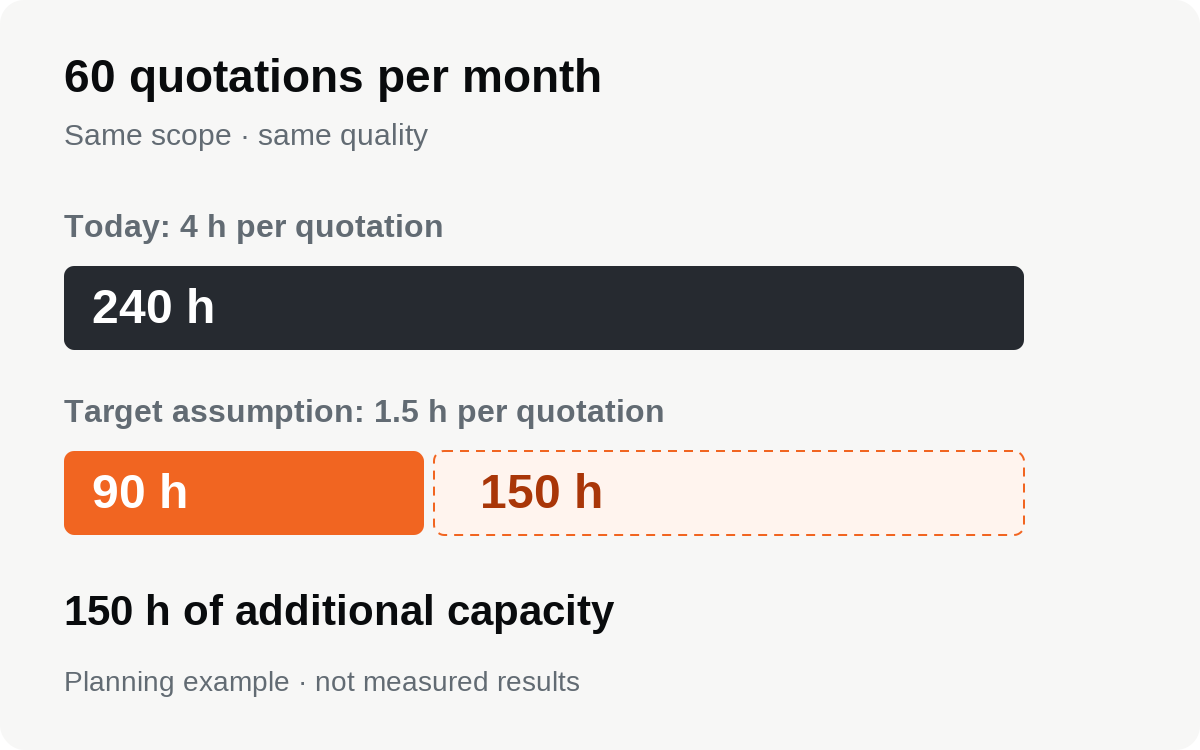
Initially, this figure describes a calculated potential. Employees remain employed, demand does not automatically increase, and other process steps may limit throughput. Multiplying the 150 hours by an internal hourly rate gives an imputed capacity value. It does not establish an equivalent reduction in actual expenditure.
Three questions turn potential into a business case
1. Capture the full workload
A draft produced in minutes is of little help if substantial corrections follow. Suppose each quotation needs another 15 minutes of rework outside the planned one and a half hours. Monthly work then rises from 90 to 105 hours. Potential capacity falls from 150 to 135 hours. If rework is already included, it must not be deducted again.
2. Account for actual adoption
If only 40 of the 60 quotations can use the new process and the rest still take four hours each, the additional capacity is 100 hours. That may remain attractive, but it is a different basis for investment. Different trip types, incomplete partner documents and special requests should therefore be represented in the pilot.
3. Put the time gained to a specific use
The business case needs a concrete use for the capacity. The team could handle more qualified enquiries, respond faster or reduce paid overtime. Each option has a different economic effect and needs its own evidence.
These two adjusted calculations are separate scenarios. If limited adoption and additional checking occur together, both effects must be calculated together.
Assess capacity, growth and savings separately
Management benefits from a clear distinction:
- Additional capacity: The team can take on more work. Suitable tasks and the availability of the required skills are decisive.
- Additional contribution margin: Handling more enquiries may lead to more sales. This requires demand, a credible conversion rate and capacity to deliver the resulting services. Additional revenue alone is not additional profit.
- Avoided or reduced expenditure: Examples include an actual reduction in paid overtime or external services. These amounts can be compared with additional operating costs.
The same hour must not be valued both as a cost saving and as capacity for additional revenue. Where several effects are expected, allocate the available time to the respective uses.
One-off costs include implementation, interfaces, data preparation, training and internal project work. Recurring costs may include licences, model usage, operations, support and changes. Case-specific review is already part of processing time; additional system maintenance is recorded separately.
For a simplified payback calculation: Divide the initial investment by the positive monthly net cash benefit to obtain the payback period in months. That benefit must contain credibly achievable financial effects minus additional recurring costs. An imputed capacity value alone is insufficient. A detailed calculation must also account for the ramp-up period and fluctuating utilisation.
Test the assumptions in a pilot
Before starting, the business team and IT jointly define what counts as a finished quotation. They then measure comparable cases with and without AI assistance. Selecting only particularly easy enquiries would distort the decision. Abandoned cases, exceptions and rework also belong in the assessment.
A compact measurement sheet is enough to get started:
| Measure | What it establishes | |---|---| | Active working time until the quotation is ready to send | The actual human effort involved | | Elapsed time from receipt to dispatch | Whether customers receive a quotation sooner | | Review and correction effort | Whether gains are lost elsewhere | | Errors, missing information and follow-up questions | Whether the result meets the agreed quality standard | | Share of suitable cases and cases actually processed | How broadly the new workflow works in everyday use | | Additional recurring costs and support time | How much benefit remains in operation |
Working time and elapsed time are measured separately: two days waiting for a partner are not two days of work. Equally, a faster internal step may change little for the customer if that waiting time remains.
Before the pilot, also define the minimum acceptable quality, the impact that would justify investment and who will review the results. The measurement period depends on case volume, variations and seasonal differences.
The decision behind the 150 hours
The first management task is to select a clearly bounded process, measure today's workload and define how additional capacity would be used. Only then can you judge whether the planning assumptions fit your own organisation.
A convincing AI business case therefore shows more than time saved. It connects verifiable process improvements with realistic operational value, complete costs and clear responsibility for implementation.
Would you like to assess such a process in your organisation? We help connect the baseline, pilot and economic assessment. Talk to us about your specific workflow.
Basis of the calculation and further information
The calculation comes from Deep Impact's CLEO product presentation: 60 quotations a month, four hours today and a target assumption of one and a half hours. It is explicitly a planning example. The rework and limited-adoption scenarios are additional hypothetical calculations in this article. They contain no customer data, measured performance figures or CLEO pricing.