The future of support: Which cases should agents handle?
Which support cases suit AI agents? Define responsibilities for agents and people, then assess service quality, human effort and the economic benefit.
By Christian Fehrlin

A customer writes for the third time about the same delivery. The first reply was quick; the second gave a different date. Now she wants someone to take ownership. This is where AI's value in support is decided: are replies merely faster, or does the case actually move forward?
The management decision is therefore about responsibility: what may an agent take on? A useful division of work starts with the case, limits potential harm and measures confirmed outcomes. Released time becomes economically valuable only when the business can use it. This article offers a decision framework; it claims no results from a customer project.
Not every support task needs an agent
An agent combines a language model with authorised data sources and tools. It can gather information and choose subsequent steps based on results. A simple status enquiry, however, may need only an existing self-service function. A fully specified sequence can run as a conventional workflow. Anthropic distinguishes predefined workflows from agents choosing tools dynamically.
Check the simpler solution first. An agent becomes interesting when requests vary, information must be combined across sources and follow-up questions depend on context. It cannot replace an unresolved shipping rule or an unreliable knowledge base.
Which cases should come first?
Our proposal: choose a frequent case category with an observable outcome. Assess four criteria: are sources current and accessible? Is the permitted action clear? How serious would an incorrect answer or change be? Can success be checked independently of the agent's reply?
If a foundation is missing, begin by clarifying data and processes. For the remaining cases, distinguish rule clarity from the consequences of failure. The following map is a design aid, not an automatic grant of permissions.
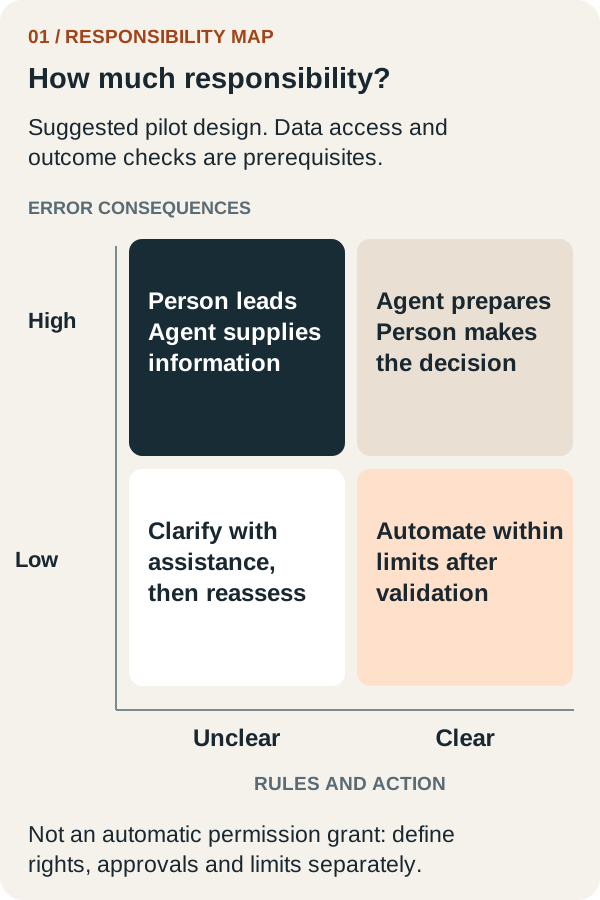
| Example | Useful starting role | Boundary |
|---|---|---|
| Status of an identified order | Retrieve and explain the current state | No new delivery promise when sources conflict |
| Known technical question | Prepare instructions with a relevant source | Unclear environments or risky interventions go to a person |
| Change a delivery address | Check eligibility and prepare the change | Execute only under the defined rule and required approval |
| Complaint requesting a credit | Gather evidence and options | Goodwill, amount and binding commitments initially stay with a person |
The largest category is not necessarily the best pilot. High volume with unclear contractual exceptions may be less suitable than a smaller, well-defined process. Conversely, an easily automated case must consume enough effort to justify connecting it.
What the research does—and does not—establish
A field study published in 2025 examined AI assistance for 5,172 support employees at one company. Resolved issues per hour increased by 15% on average. People retained responsibility and could edit or ignore suggestions. The authors also found small quality declines among the most experienced, highest-performing employees. This supports assistance under those conditions; it neither proves autonomous support nor predicts your results. Generative AI at Work
Measure by case category and employee experience. An average can conceal one group working faster while another spends more time correcting output.
100 hours become 80—under these assumptions
Consider an explicitly hypothetical monthly example. Previously, 600 cases required ten minutes of human work each: 100 hours. In the pilot, 300 largely automated cases require two minutes each, or ten hours. The other 300 require twelve minutes, totalling 60 hours. Add ten hours for sampling, upkeep and resolving errors. The calculation assumes a comparable case mix and at least equivalent resolution quality.
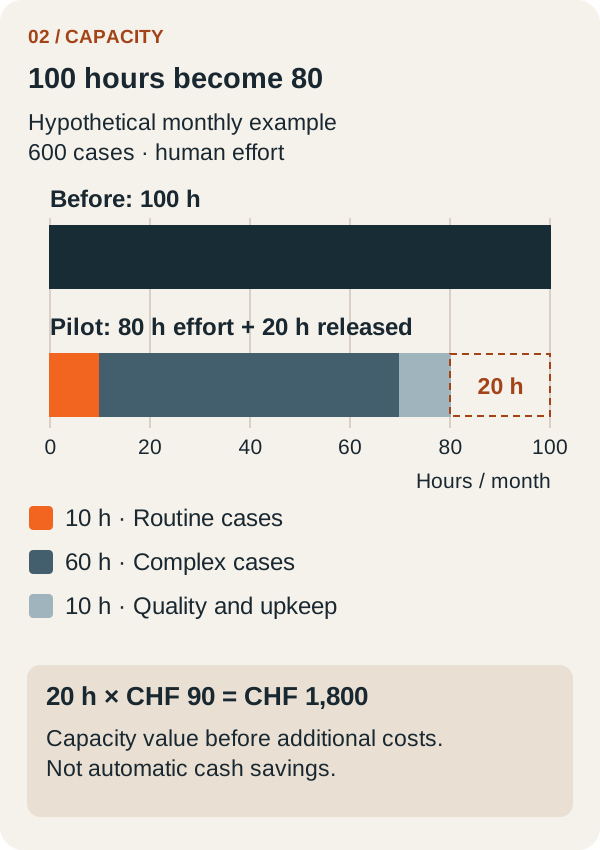
That leaves 80 hours of work and 20 hours of calculated capacity release. At an assumed CHF 90 per hour, this represents CHF 1,800 of monthly capacity value. It becomes useful when the team can clear backlogs, handle additional volume or actually avoid external costs. Without such a use, released time is not yet a realised financial benefit.
Licences, model usage, integration, operations and implementation are still excluded. For a business case based solely on this capacity value, additional recurring costs must be below the benefit that can actually be realised; implementation must then be recovered. Better service quality may add value but needs separate evidence. Do not count the same hours again as staffing cost savings. Further reading: cost per resolved AI case.
A pilot needs acceptance criteria, not just a demo
We propose three stages. First, the agent works on approved test cases without affecting customers. Next, it prepares real cases while people decide. Only after business acceptance does it receive narrowly defined execution rights. Each new case category needs its own assessment.
Compare similar cases before and after, using the same observation window. Define what “resolved” means for the pilot: the promised outcome is confirmed, and the same problem does not recur within a specified period. For information-only cases, factual correctness matters too. A lack of further customer contact alone does not prove resolution.
| Measure | What to count |
|---|---|
| Resolution rate | Substantively confirmed resolutions divided by all cases admitted; report abandoned and handed-over cases separately; distinguish automatic, reviewed and human resolutions |
| Reopenings | The same issue within the agreed window, including through another channel |
| Human effort | Handling, follow-up questions, review and rework per case; shared upkeep in addition |
| Service quality | Samples checked for correctness, complaints and customer feedback with its response rate |
Set quality thresholds before starting, by case category. There is no universally suitable success rate. Our recommendation is that an unauthorised write should immediately stop execution, even when average resolution rates look good. Agent tests should examine the actual final state, not just a convincing success message.
Operating an agent means retaining responsibility
Support leadership owns case selection, service quality and handovers; IT owns access, traceability and shutdown. A named business owner approves new actions, while Finance checks realisable value. Customers need a clear route to a person who receives the existing context.
Permissions belong in connected systems, not only in model instructions. A customer attachment must not create extra rights. Logs need restricted access and appropriate retention. OWASP recommends minimal functions and permissions, plus human approval for consequential actions.
After changes to the model, rules or tools, rerun the critical test cases. Operations must be able to return to human handling when problems arise. These organisational prerequisites are part of the investment. Deep Impact's AI-agent approach similarly describes bounded tasks, system access and approvals.
The initial brief is now concrete: one case category, a confirmed target outcome, permitted actions, an accountable owner and an acceptance procedure. That is how support can take ownership and move requests forward reliably. Scope a support pilot with Deep Impact.