AI Agents and Operators: The Next Level of Intelligent Automation
While Large Language Models are already widespread, the next stage of development goes beyond them: AI agents and operators. These systems are designed to autonomously manage complex business processes.
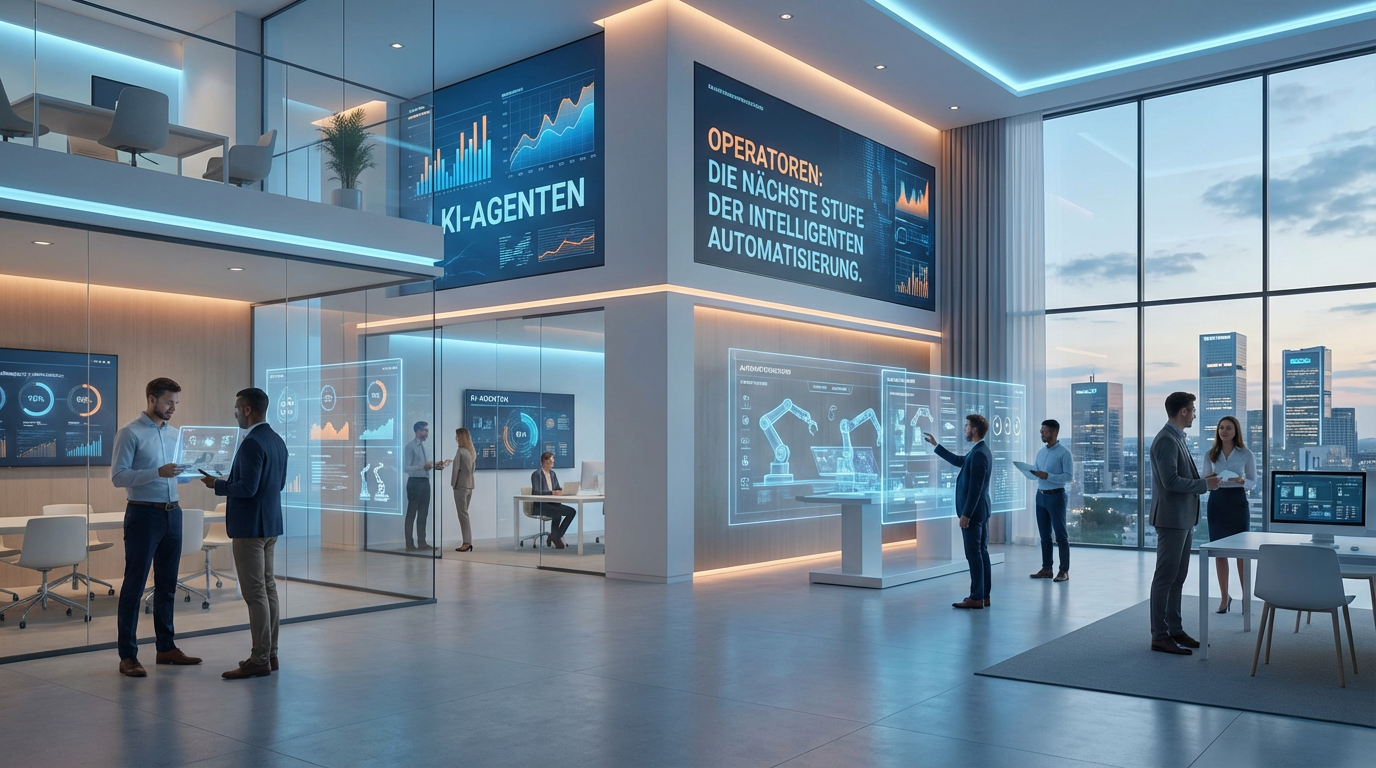
English edition — originally published in German as KI-Agenten und Operatoren: Die nächste Stufe der intelligenten Automatisierung.
What Differentiates AI Agents from LLMs?
LLMs: The Foundation
Large Language Models (LLMs) like GPT-4, Claude, or Gemini are powerful tools for text processing:
- Generate text: Summaries, reports, emails
- Answer questions: Based on training data
- Write code: With the help of prompts
But: LLMs are reactive. They wait for input and generate output.
AI Agents: The Evolution
AI agents go a step further:
- Autonomy: They act independently according to defined goals
- Tool use: They can use external tools and APIs
- Planning: They break down complex tasks into sub-steps
- Persistence: They remember context across interactions
- Feedback loops: They learn from results
AI Operators: The Orchestration
AI operators are the next level of abstraction:
- Multi-agent coordination: They control multiple AI agents
- Workflow management: They orchestrate complex business processes
- Escalation: They decide when human intervention is needed
- Monitoring: They monitor system states and react proactively
Use Cases
1. Automated Software Development
An AI agent can:
- Write code based on requirements
- Generate and execute tests
- Create pull requests
- Perform code reviews
An AI operator coordinates multiple developer agents for an entire project.
2. Customer Service
- First-level support: Agents answer routine questions
- Escalation: Complex cases are forwarded to humans
- Follow-up: Agents proactively follow up on open tickets
3. Data Analysis
- Automatic reports: Agents create regular reports
- Anomaly detection: Operators identify deviations
- Recommendations: Based on data analysis
4. DevOps
- Deployment automation: Agents perform releases
- Incident response: Operators react to system problems
- Capacity management: Automatic scaling
Challenges
Reliability
- Hallucinations: Agents can generate false information
- Edge cases: Unexpected situations can be problematic
Control and Transparency
- Audit trail: What did the agent do and why?
- Debugging: What does the agent do in case of errors?
- Change management: Teams must learn to work with agents
The Deep Impact Strategy
At Deep Impact Services GmbH, we use AI agents for:
- Faster development: Automation of routine tasks
- Quality assurance: Continuous quality gates
- DevOps optimization: Intelligent operators
- Team empowerment: Junior developers are supported
Our Approach:
- Clearly defined tasks: Agents need precise tasks
- Human oversight: Critical decisions remain with humans
- Iterative improvement: Agents learn and get better
- Transparency: Every action is logged
Conclusion
AI agents and operators are not the future – they are the present. Companies that experiment today will be dominant tomorrow.
The most intelligent software emerges when people combine their strengths with AI agents.